People love to complain about greatness as it’s happening. Greatness in sports inherently means predictability, because great athletes win a lot. In men’s pro cycling, Tadej Pogacar is showing this right now. He wins when he crashes. He goes solo for 100km and wins. In the rare cases he doesn’t win things still look off: he’s been runner-up at Paris Roubaix for two years running now, despite being listed between 7 and 19 kg lighter than every other rider in either top 10. It can, without doubt, feel like things are a bit predictable. It can be a little boring.
But Tadej is good for cycling. Greatness is what sports are, in the end, about. In my mind, a healthy sport takes great athletes and pits them against each other. Ideally the pitting is under fair conditions, or even better, slightly unfair conditions that benefit of the underdog. When great athletes and teams have the odds stacked against them, it means fierce competition: it lets true champions show their mettle. There is nothing worse than a great athlete that gets to play on easy mode.
Many sports go to great lengths to achieve this parity between teams, with drafts that give the early picks to teams with the worst record, salary caps that mean teams must trade off great riders with depth, etc. Nothing like this exists in cycling. Instead, there are more organic forces that pull teams together - towards parity - and some that push them apart. Great riders often don’t want to play second fiddle; this can spread talent out, as good teams must overpay if they want to bring in multiple top riders. And there are usually diminishing returns to greatness: the incremental million dollars spent by a top team probably gets less value than the same money spent by a poorer team.
But there are also forces working in the wrong (to me) direction. Sponsors like great riders and teams, so wins often lead directly to increased budgets. And because these forces are organic, this can be a delicate ecosystem. Especially in a relatively small (and poor) sport like cycling, it doesn’t take much for this parity to be disturbed. Right now, I think that is happening: we’re seeing a predictable cycling, a cycling where David defeats Goliath less and less frequently. This problem is exemplified by UAE Team Emirates, but it’s a phenomenon that runs deeper than one team.
The best teams are winning more than ever.
This is true not just of the best team each year, but the 2nd, 3rd, 4th and 5th best teams too: across the board since about 2010, top teams are gobbling up more wins each year (and are right now winning more than at any point since 1960).
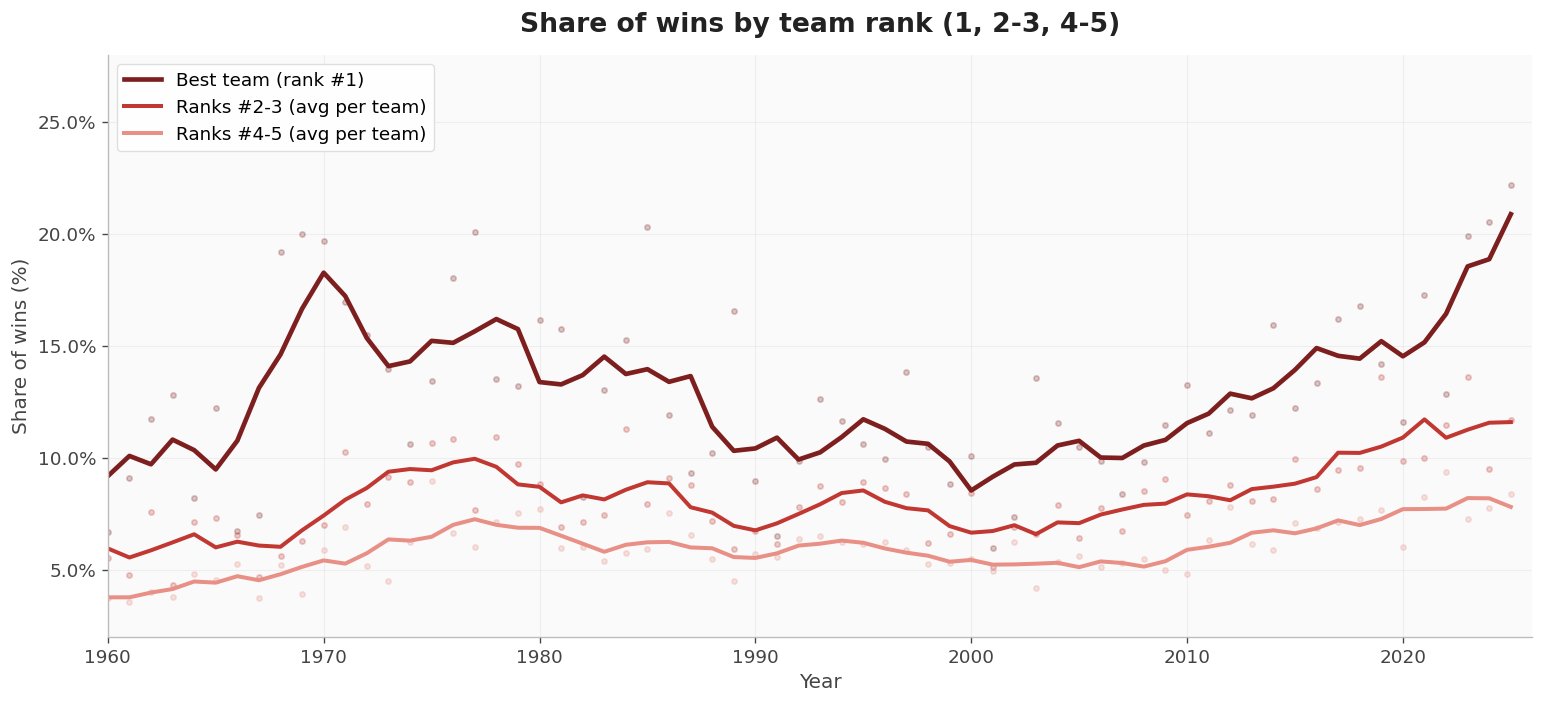
For this graph (and the following graphs) I’m using the top 20 stage races and top 40 one day races each year, to get a relatively stable sample of ~300 win opportunities each year. I’m also including wins that have been invalidated to better compare today’s viewing experience with years in the past.[1]
[1]
Success in cycling is very hard to define, and any way you do has value judgements built in. My method here counts a Tour de France win the same as a win in Dwars door Flaanderen, which is certainly not accurate, but I've chosen it because it allows clean comparison far back in time. It also also stage wins relatively highly - most wins each year are stage wins.If we weight by race importance (using PCS points, Pro Cycling Stats’ version of UCI points, which go back to 1960), the growth since 2010 still exists, but current teams can’t compare to the great teams of the 70s. Those early teams of Merckx and company won more top races even as they won fewer races , partly as a function of teams then being smaller and starting fewer races overall.
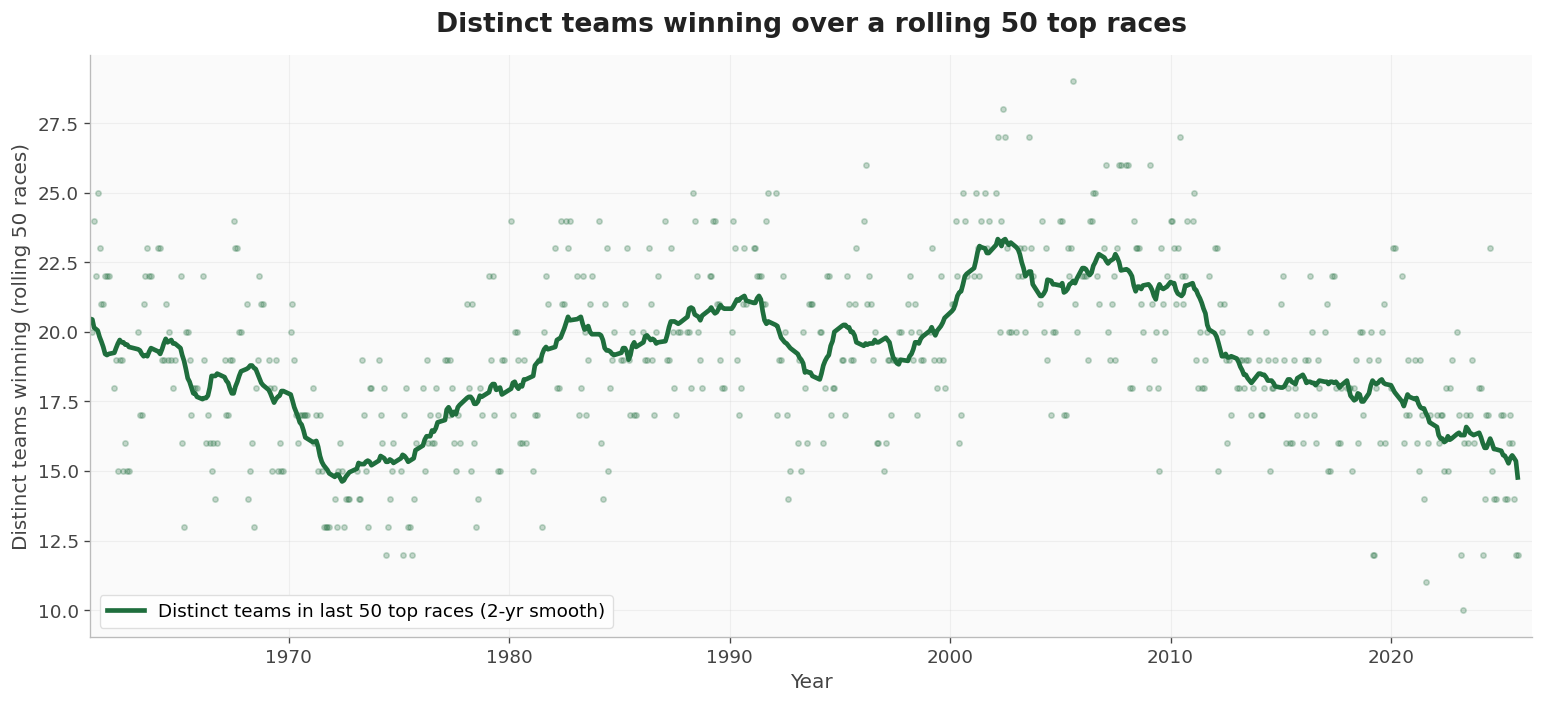
The reverse is true too: at any point in time, look at the last 50 races, and count the number of teams with at least one win. Fewer teams have a win than any year since the 70s, again with a consistent trend down since 2010.
What’s further concerning is that this is still true if you remove each team’s best rider. This isn’t driven by single freakish athletes like Tadej or Mathieu, but by a wholesale shift across teams’ rosters.
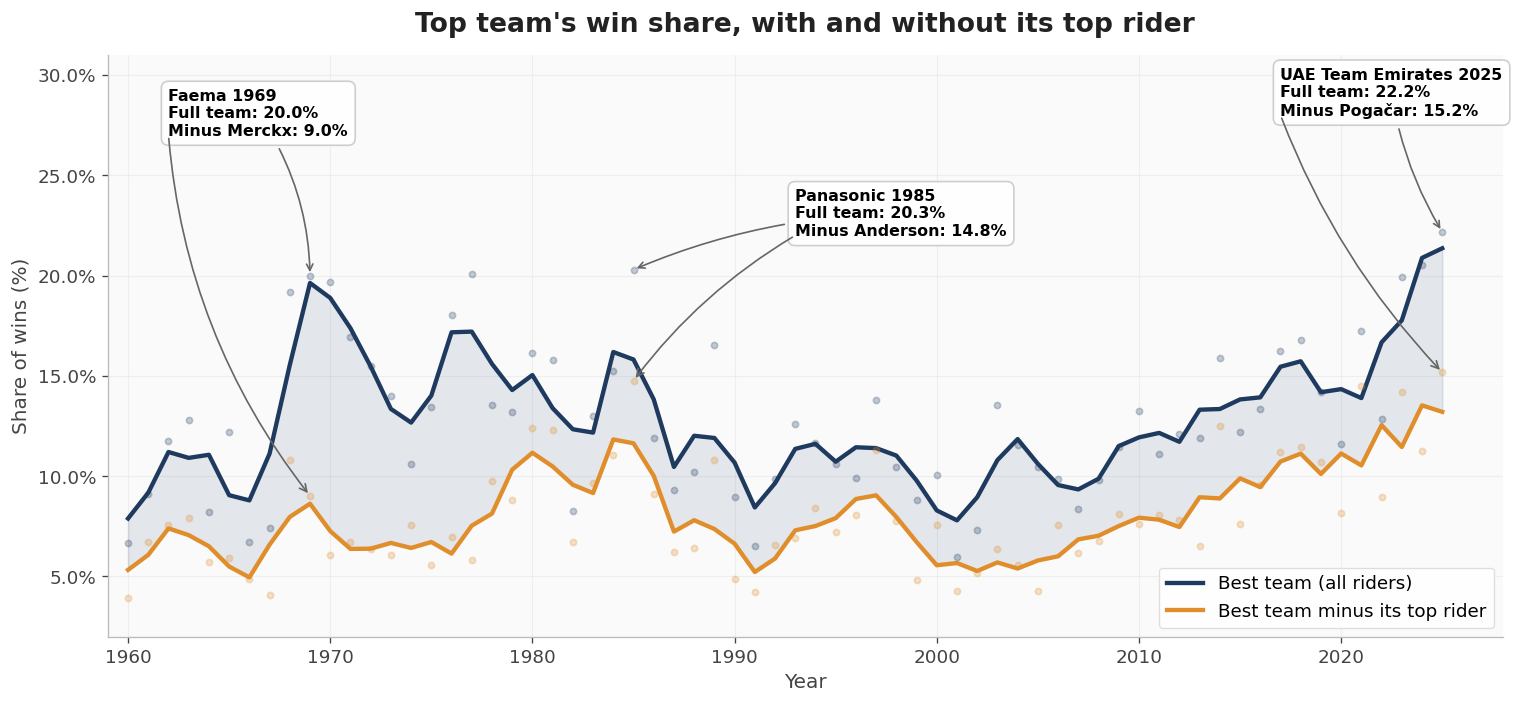
There has clearly been a drop in parity across the peloton, and it’s been going in that direction for 10 or 20 years.
How? Better Riders and More Predictable Races
Top teams have tended to sign better veteran cyclists than worse teams, and gotten more year-on-year improvement out of their young cyclists. And the gap for both is widening:
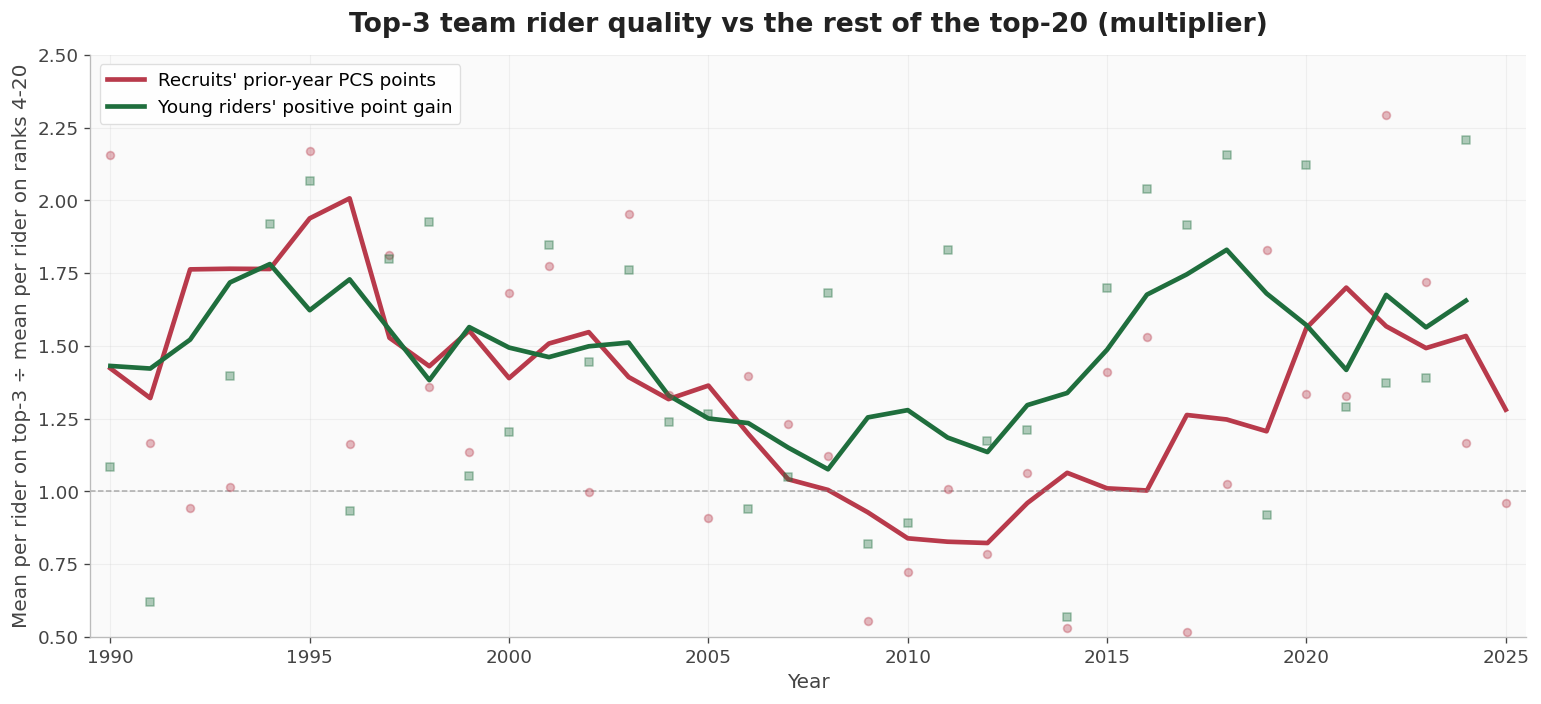
This means that the top 3 teams are picking up riders with 25% more points in the prior year than other teams, and their young riders grow 60% more each year. That is a huge gap! To compound this, since 2000, there has been a trend for all teams - top and bottom - to recruit younger riders.
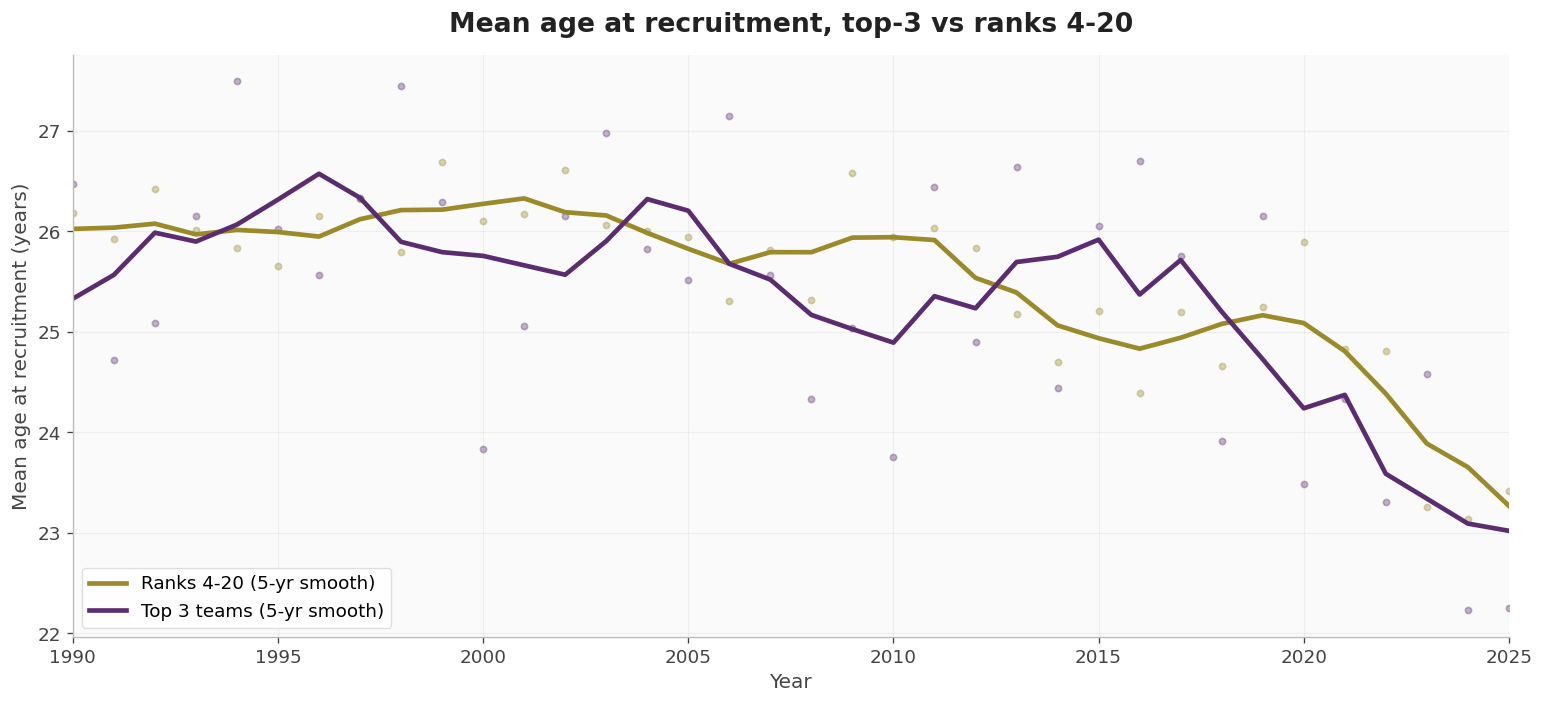
And retention (% of roster who stays on the team next year) is up across the board, and is now nearly even across the top-20 teams: 82% for top-3 teams vs 79% for teams 4-20 overall, and 89% vs 82% for each team’s top-5 point-scorers. It’s up by 10-35 percentage points across the board since 1990 — good riders, young riders, top teams and the rest.
These three phenomena all benefit the best teams: everyone signs younger riders; the best teams get more gains out of them each year, and those gains compound more because those teams hold onto them more easily than others. There is a shift here that entrenches the strongest teams (even more-so than before) at the top.
During races things are similarly tilting towards the strongest teams. Breaks get less leash over the last 10 years and more solo wins from longer away. To me, these changes mean that good riders can win more often - or in other words, there is less variance in race winners.
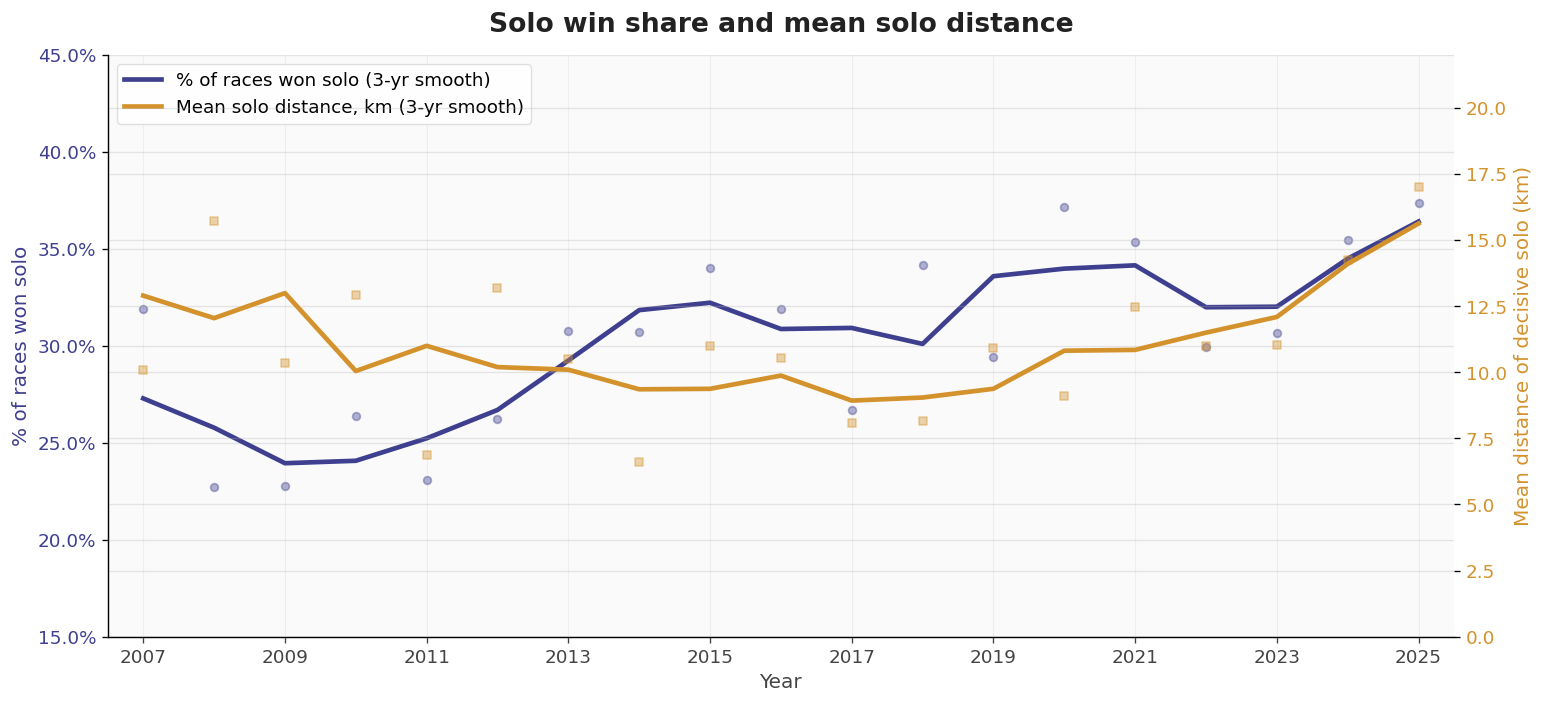
Teams who are much stronger than their opponents and have the best rider in the race can ride the front all day, keep early breaks from gaining any real advantage, and then have their rider attack on a steep climb and ride away from everybody.
Teams in the top 3 of GC podiums at Grand Tours are also winning more stages in those Grand Tours in the last 5 years than any period since 1990. Again pointing to this idea that the top teams are so dominant that they don’t need to trade off quite as much between overall results and stage wins.[2]
[2]
Also, potentially, that improved nutrition allows harder riding day-after-day. Again allowing the best teams to try to win every stage, and leaving fewer opportunities for everybody else.Where does this leave us
First let’s talk about what else could be going on, besides team finances. Races are faster than they’ve ever been, as riders are stronger and more aerodynamic; maybe this can help explain the shorter breakaway leashes, the longer solos, and some of the loss of predictability. Larger groups create variance, and if it’s easier to go alone, it’s easier for better riders to win.
Riders are also eating more than they ever have before, during races and training. This could also help explain things in the same ways: good teams can ride the front all day more now that they have the carbs coming in, and as above, this could help explain GC teams winning more stages now.
But it’s impossible to escape the obvious answer: there is a huge disparity in spending between the top and bottom teams in the WorldTour. The evidence here says that more likely than not, that disparity is increasing. We don’t have good data on team in cycling: it’s one of a select few professional team sports that don’t have some form of spend transparency. From what we do know — from reports from industry insiders to places like Escape Collective — UAE is spending $60 to $65M a year in 2026. The bottom World Tour and top Pro Tour teams are spending something like a quarter of that (Intermarché-Wanty reports €14M, Lotto sits “closer to €15M than €20M”).
This ~4x multiplier isn’t actually isn’t a huge gap compared to other sports: it’s closer to the NBA at ~3x (with its salary cap, luxury tax and revenue sharing) than it is to the Premier League at 16x.
Parity by League
| League | Top Team Spend | Bottom Team Spend | Spend × | Top Team Win% | Bottom Team Win% | Win% × |
|---|---|---|---|---|---|---|
| Cycling — top race set (2025) | UAE Team Emirates — ~€60-65M (~$68M) | Intermarché-Wanty — €14M (~$15M) | 4.5× | UAE — 22.2% (57 of 257) | Intermarché-Wanty — 0% (0 of 257) | ∞ |
| F1 (2025) | Mercedes — ~$680M (FY2023) | Williams — ~$158M (FY2023) | 4.3× | McLaren — 58.3% (14 of 24) | Haas (and 6 others) — 0% (0 of 24) | ∞ |
| Premier League (2024-25) | Manchester City — £224M (~$285M) | Ipswich Town — £40M (~$51M) | 5.6× | Liverpool — 6.6% (25 of 380) | Southampton — 0.5% (2 of 380) | 12.5× |
| Bundesliga (2024-25) | Bayern Munich — €264M (~$285M) | Holstein Kiel — €12M (~$13M) | 22.6× | Bayern Munich — 8.2% (25 of 306) | Holstein Kiel / Bochum (tied) — 2.0% (6 of 306) | 4.2× |
| NBA (2024-25) | Phoenix Suns — ~$414M | Detroit Pistons — ~$142M | 2.9× | OKC Thunder — 5.5% (68 of 1,230) | Utah Jazz — 1.4% (17 of 1,230) | 4.0× |
| NFL (2024) | Cleveland Browns — ~$346M | Dallas Cowboys — ~$189M | 1.8× | Lions / Chiefs (tie) — 5.5% (15 of 272) | Browns / Titans (tie) — 1.1% (3 of 272) | 5.0× |
| NHL (2024-25) | Washington Capitals — ~$123M | San Jose Sharks — ~$80M | 1.5× | Winnipeg Jets — 4.3% (56 of 1,312) | San Jose Sharks — 1.5% (20 of 1,312) | 2.8× |
| MLB (2025) | LA Dodgers — $345M | Miami Marlins — $69M | 5.0× | Milwaukee Brewers — 4.0% (97 of 2,430) | Colorado Rockies — 1.8% (43 of 2,430) | 2.3× |
Cycling does not seem to have a spend disparity relative to many other leagues, and yet it has a really rough win disparity. The win disparity is what we care about here so I don’t think we should take much solace in the relative spend parity; it just shows that those organic forces towards disparity are strong in cycling.
Many sports have implemented many different attempts to create spending parity and transparency.
Parity Mechanisms by League
| Sport | Hard cap | Soft cap / ratio | Lux. tax | Player max | Floor | Draft / auction | Rev. share | Public spend |
|---|---|---|---|---|---|---|---|---|
| NFL (US football) | 🟢 | 🔴 | 🔴 | 🔴 | 🟡 | 🟢 | 🟢 | 🟢 |
| NBA (basketball) | 🟡 | 🟢 | 🟢 | 🟢 | 🟢 | 🟢 | 🟢 | 🟢 |
| NHL (hockey) | 🟢 | 🔴 | 🔴 | 🟡 | 🟢 | 🟢 | 🟢 | 🟢 |
| MLB (baseball) | 🔴 | 🔴 | 🟢 | 🔴 | 🔴 | 🟢 | 🟢 | 🟢 |
| IPL (cricket) | 🟢 | 🔴 | 🔴 | 🟡 | 🔴 | 🟢 | 🟢 | 🟢 |
| La Liga (soccer) | 🟢¹ | 🟢 | 🔴 | 🔴 | 🔴 | 🔴 | 🟢 | 🟢 |
| Premier League (soccer) | 🔴 | 🟡² | 🔴 | 🔴 | 🔴 | 🔴 | 🟢 | 🟡 |
| EuroLeague (basketball) | 🔴 | 🟢 | 🟢 | 🔴 | 🟢 | 🔴 | 🟢 | 🟡 |
| NRL (rugby league, Aus.) | 🟢 | 🔴 | 🔴 | 🔴 | 🟢 | 🟢 | 🟢 | 🟡³ |
| 🚴 Pro cycling (UCI WT) | 🔴 | 🔴 | 🔴 | 🔴 | 🟢⁴ | 🔴 | 🔴 | 🔴 |
Cycling is a clear outlier here, having done essentially nothing to help smaller teams. Salary caps and other solutions have been discussed — by commentators (Lanterne Rouge, Escape Collective) and recently in more official channels as well. But you can pin holes in any one of these solutions, and the urge to stay pat is strong, especially for the notoriously archaic UCI.
INSERT MY GREAT SOLUTION HERE
We need to think about this with a long-term view. Cycling needs to be exciting, to be dynamic and unpredictable. Races need to be won by athletic feat, by tactics and teamwork. Being won because an owner could field the most investment from sometimes-shady avenues is not exciting to watch or inspiring to follow.
Ultimately, I believe we are being deprived of the best possible experience: of seeing the greatest rider ever race fairly against the world. Right now, the best rider has the best team, and that is a tragedy.